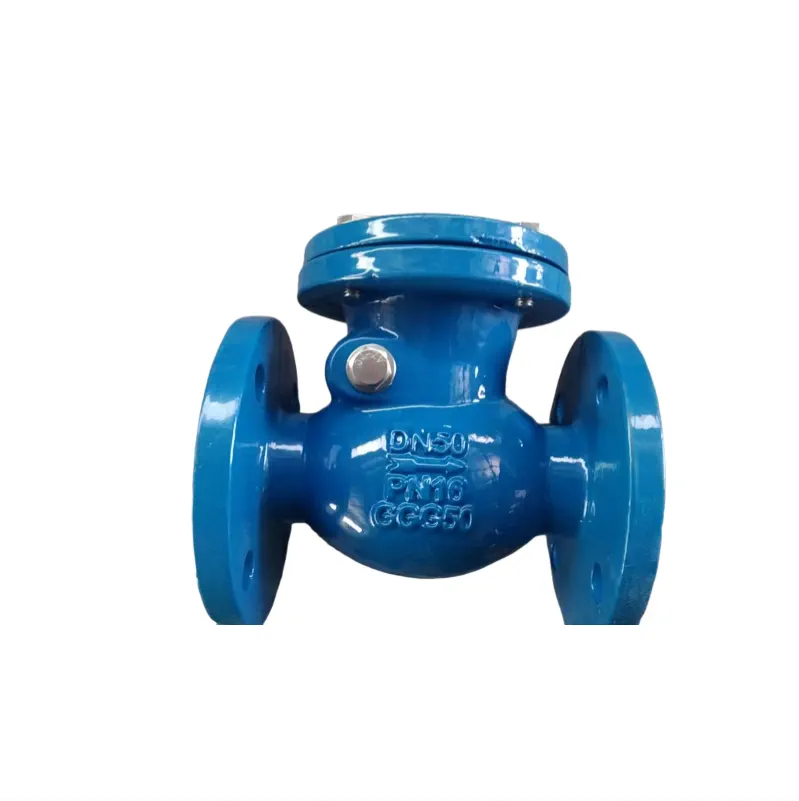
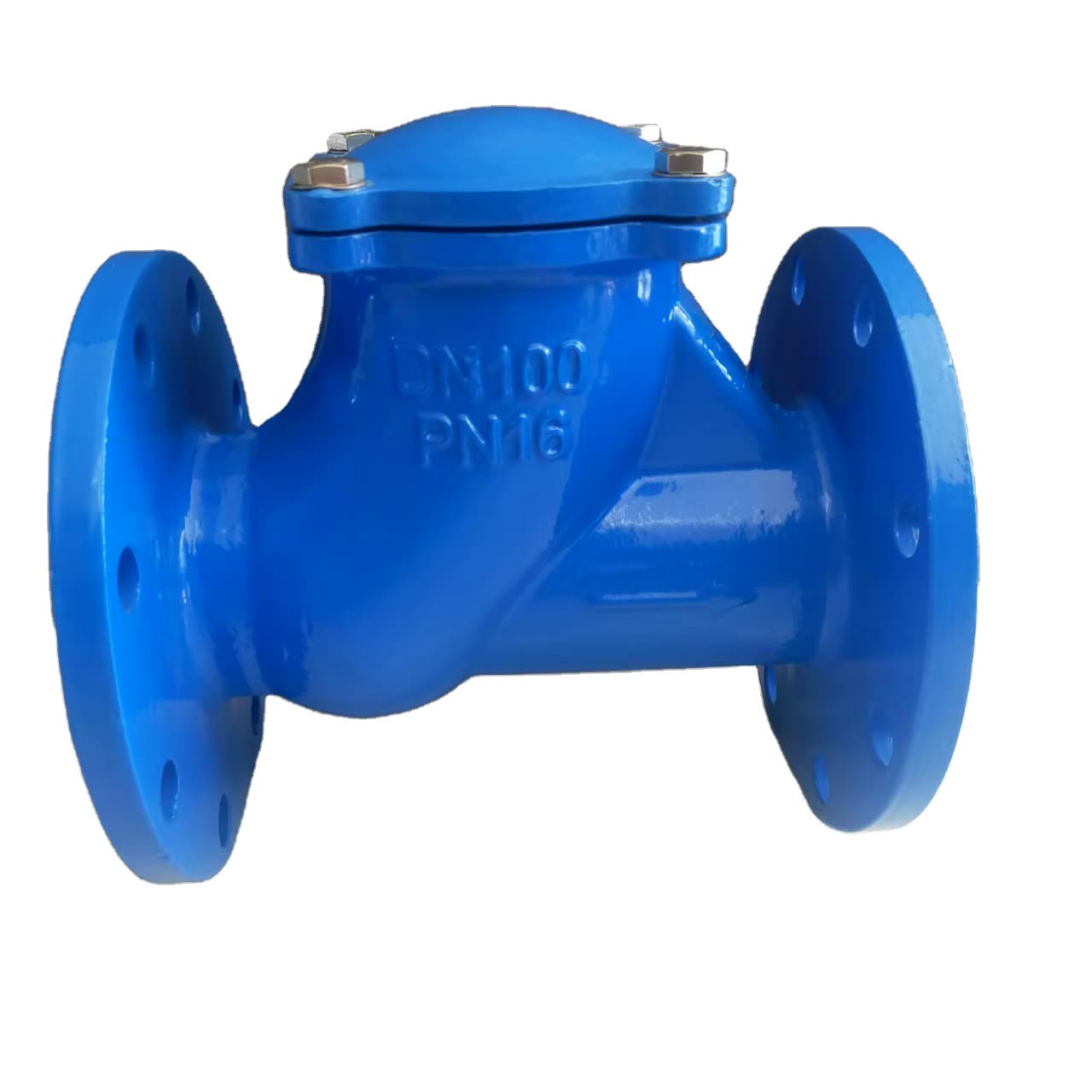
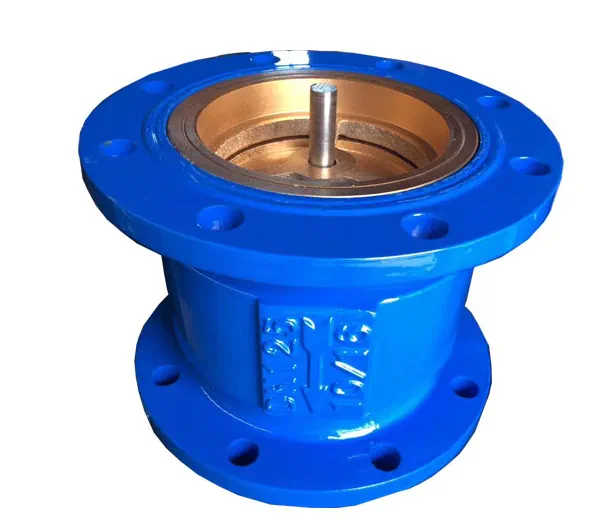
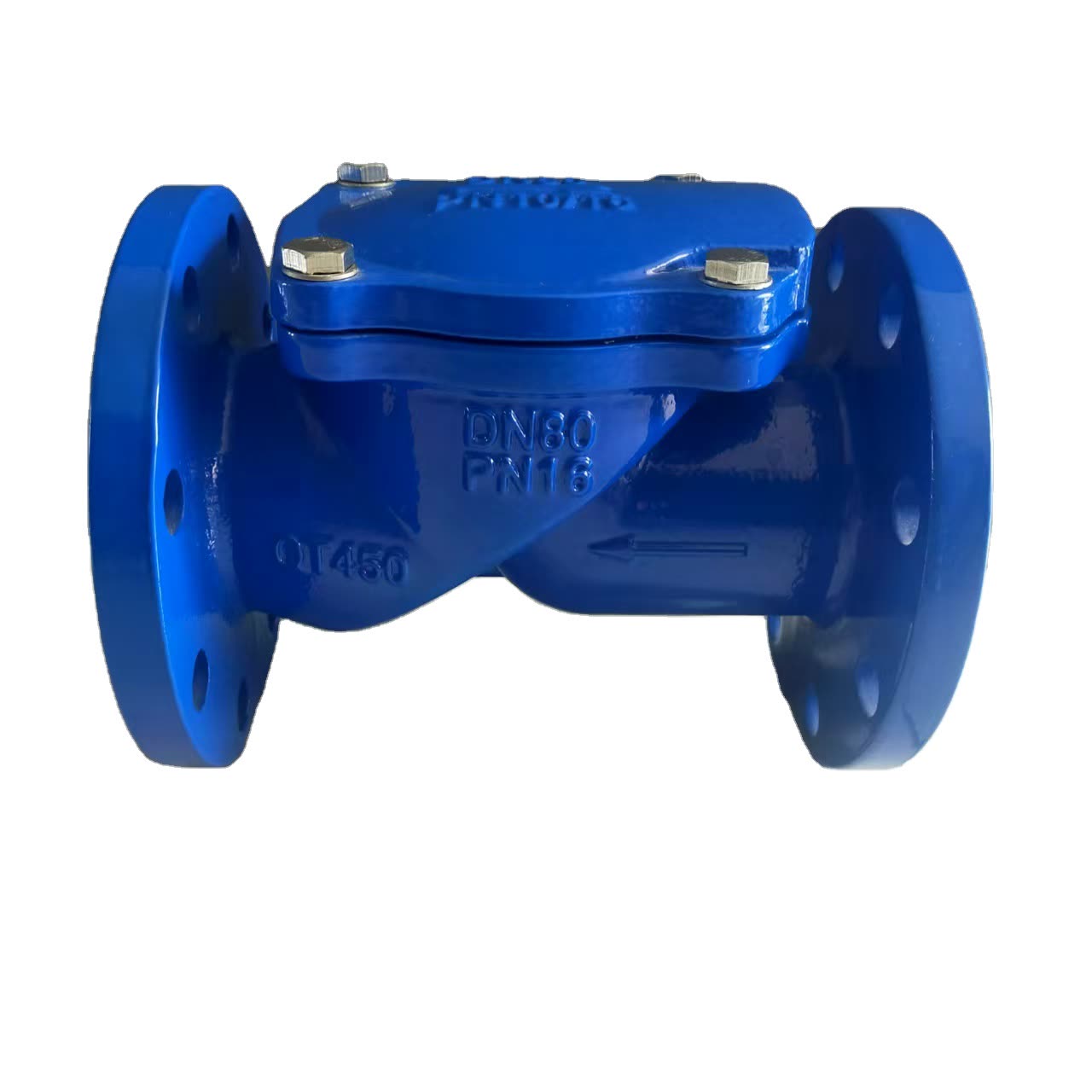
The swing check is the low-loss non-return: full bore, a hinged disc that lifts clear of the flow, so it costs a few hundredths of a bar where a spring-loaded valve costs a tenth. DIN F6 face-to-face, DN50–DN400, brass-welded or EPDM seat, 304 guide shaft. What it does not do is close fast — the disc falls back on its own, and on a pump discharge with a long rising main that lag is the water hammer. Pair it with a slow-closing valve, or take the silent check, where the surge is the problem rather than the head loss.
General Specifications
Size RangeDN50 – DN400
ModelDIN F6-H44T
Pressure RatingPN10 / PN16 (PN25 on request)
End ConnectionDouble flanged
Flange DrillingBS EN 1092-2 (DIN 2501)
Disc SeatBrass welded / EPDM
ServiceHigh-flow pipelines, fire and municipal mains, wastewater
Max. Working Temperature70 °C standard (EPDM) — NBR for 80 °C, FKM for up to 150 °C on request
Materials & Coating
BodyDuctile iron, epoxy coated; duplex 2205 / 2507 available on request
DiscBrass-welded or EPDM-faced swing disc
Guide Shaft304 stainless steel
TrimStainless steel (grade per order)
Design Features
DesignFull-bore swing — minimal head loss
Applications
High-flow pipelines Wastewater Irrigation Process water
Full-bore swing: what you gain, what you accept
A swing check is a disc on a hinge. At forward flow it is pushed out of the bore, so the valve adds almost nothing to the line's resistance — and on a continuously running pumping line that matters more than the purchase price, because the pumping energy wasted across a check valve over a year can exceed what the valve cost several times over.
What you accept is closing behaviour. The disc is pushed shut by reverse flow, so it closes after the flow has already begun to reverse. On a large line with a fast-stopping pump that is a surge question, and it is the reason a swing check is often paired with a surge arrangement rather than asked to do that job alone.
Brass-welded face or EPDM face
Both are disc faces, and they answer different water. A brass-welded face is metal against metal: it tolerates higher temperature and water that would attack rubber, and it survives the grit that finds its way into a fire main after a main break. An EPDM face gives a softer seal where clean water and drip-tight closure matter more than temperature.
The body is epoxy-coated ductile iron and the guide shaft is stainless in both versions, so the face is the part that decides the duty. State the medium rather than picking the cheaper face.
Orientation is not optional
A swing check relies on gravity to bring the disc back to its seat, so it is installed in horizontal pipe with the cover upwards, or in vertical pipe with flow going upwards. Installed in vertical downflow, the disc hangs open and the valve never closes — a failure that looks like a missing check valve rather than a broken one.
The disc also has to have room to swing. On a line where the check sits close to an elbow or a reducer, the disc can be held partly open by the disturbed flow, which produces chatter and seat damage. Give it a straight length on both sides.
What to confirm on a swing check order
- Size and pressure rating — DN50–DN400 and PN10 / PN16 are the standard envelope, PN25 on request
- Disc face: brass-welded or EPDM, decided by the medium and temperature
- Installation orientation: horizontal, or vertical with upward flow — never vertical downflow
- Clear straight length upstream and downstream, so the disc can swing freely
- Whether the pump stop is fast enough to need surge protection alongside the check
- Media and temperature, since the face and the elastomer both set limits
Frequently asked
Swing check or dual-plate check?
Swing for full-bore, low-head-loss service on larger lines where closing speed is not critical. Dual-plate closes faster because the plates have less travel, which matters on pump discharge where reverse flow develops quickly. The trade is head loss against closing behaviour.
Why does orientation matter so much?
Because gravity returns the disc to its seat. Horizontal pipe with the cover up, or vertical pipe with upward flow, works. Vertical downflow leaves the disc hanging open and the valve never closes — it looks like there is no check valve in the line at all.
Brass-welded face or EPDM face?
Brass where the water is dirty, hot, or likely to carry grit — fire mains after a break are the classic case. EPDM where clean water and a soft, drip-tight seal matter more than temperature. The medium decides, not the price.
How much head loss does it cause?
A full-bore swing check is close to the lowest-loss non-return pattern available, which is why it is used on continuously pumped mains. The exact figure depends on size, flow and disc position, so ask for it against your duty rather than taking a catalogue average.
Can a check valve be used to isolate a line?
No. A check valve is not a shut-off device — it has no operator and no guaranteed zero-leak closure. Every line that needs isolation needs its own isolating valve alongside the check.
What materials are standard?
Epoxy-coated ductile-iron body, brass-welded or EPDM disc face, 304 stainless guide shaft, with trim grade per order. Where the water is aggressive, state it so the trim can be confirmed rather than assumed.
What does the quotation state about testing?
The test regime follows the standard the order names, and both the test and the documentation are written on the quotation for that order — so the report matches the valve that was built.
More from this series
Related guides