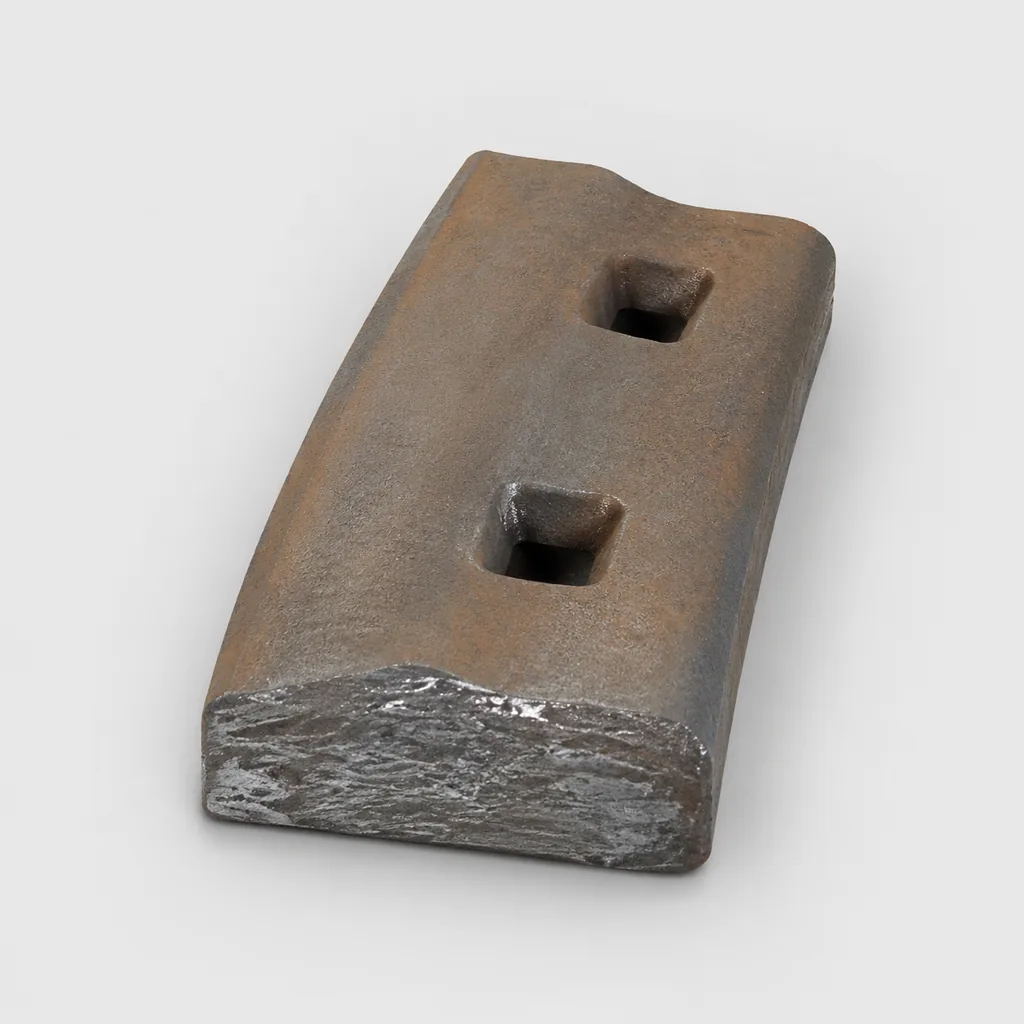
A mill liner is not a plate of steel, it is the profile that lifts the charge: wave, step and rib profiles throw the balls to different heights, and the profile has to suit the ball size and the mill speed or the mill grinds by attrition when it should grind by impact. Liners are made to the drawing, so the bolt hole pitch, the shell radius and the end liner's chamber angle are what the order is built on — a liner that fits the holes but not the radius will crack at the first heat cycle.
General Specifications
MaterialMn13Cr2 / CrMo steel
HardnessHRC 45–55 (CrMo) / HB 180–220 (Mn)
Heat TreatmentQuenching and tempering / water toughening
CastingSand casting; lost-foam available
DimensionsMade to your drawing
SurfaceShot-blasted; painted on request
MOQ1 set, negotiable
Lead TimeMade to order
Design Features
ScopeMill liners, screen plates, grid plates, side liners
ProfilesWave, step or rib profile to suit your grinding duty
Applications
Ball mills SAG mills Crushers Screen plants
A liner set is several castings, not one plate
A mill liner set is made up of castings that sit at different positions inside the mill, and each position wears for a different reason. Shell liners line the cylindrical grinding chamber. End liners protect the head and the trunnion area at both ends. Grate plates and screen panels sit at the discharge end and control what leaves the mill. Side liners close the corners where the shell meets the heads.
Because the positions differ, one mill usually needs more than one profile and sometimes more than one material inside the same set. A quotation that names a single liner type for the whole mill is not describing a complete set.
| Liner position | What it protects | What governs its design |
|---|
| Shell liner | The shell along the cylindrical grinding chamber | Profile and lifter height set how the charge is lifted |
| End liner | The head and trunnion area at either end | The plate layout must follow the head drawing |
| Grate plate / screen panel | The discharge end | The slot or hole pattern sets the discharge rate |
| Side liner | The corner where the shell meets the head | Fills the gap the shell plates cannot cover |
The profile is a process decision before a purchasing decision
In a horizontal mill the liner does more than protect steel: it decides how the grinding charge moves. That is why the profile has to be read against the duty of the specific chamber, and why the same plate shape is often right in one position and wrong in the next.
Wave, step and rib forms are the common options. All three are cast to the mill drawing, so the drawing of each position — not a single description of the mill — is what a quotation should be built from.
| Profile | Where it is normally specified | What it changes in service |
|---|
| Wave | Secondary and fine grinding chambers | A smooth lifting action that keeps the charge rolling rather than thrown |
| Step | Coarse grinding chambers where impact is high | A stronger lift, so the media falls from a greater height |
| Rib | Duties where the charge tends to slip along the plate | Added grip along the working face |
Mn13Cr2 or CrMo — what decides between them
Two material families are quoted for mill liners: high manganese steel (Mn13Cr2) and chromium molybdenum alloy steel (CrMo). The choice follows the balance of impact and abrasion at the position, not a general preference for one grade.
High manganese steel is the usual option where repeated impact from media and ore makes up a large part of the loading. Chromium molybdenum alloy steel is considered where abrasive action dominates and the duty calls for an alloy solution. In both cases the specific grade, heat treatment and hardness range are confirmed against the drawing and the recorded duty before a quotation is issued.
We do not publish a service-life comparison between the two materials. Liner life depends on the mill, the ore, the media, the profile and how the set is installed, and a claimed multiplier would not survive the first reline. What we can state is the proposed material, the position it is intended for, and the drawing reference it was quoted against.
What to send with a mill liner RFQ
A supplier who knows only the mill name is guessing. The list below is what engineering review needs before dimensions, tolerances and equipment compatibility can be confirmed — and every item on it is something the plant already has on file.
- Mill type — ball mill, SAG mill or AG mill
- Liner position for each item: shell, end, side, grate or screen panel
- The existing liner drawing, or a clear replacement drawing
- Profile of each position: wave, step or rib
- Grinding media size and ore conditions
- Main wear locations recorded during the last inspection
- Current liner condition and the reason for replacement
- Quantity — a complete set, or selected sections only
Frequently asked
Can you supply a complete liner set, or only individual plates?
Both. A set can be quoted as a full mill charge — shell, end, side, grate and screen sections — or as selected positions only, when a plant replaces one section at a time. The scope you ask for is the scope that gets quoted; there is no requirement to take a full set.
Do you need a drawing, or can you work from measurements?
The drawing is the controlling document for dimensions, openings, bolt locations, curvature and installation orientation. If no drawing exists, verified site measurements and photographs can be submitted for engineering review — the result still depends on that review and on factory confirmation, not on the measurements alone.
Which mill types do these liners suit?
Horizontal grinding mills — ball mills and SAG/AG mills — are the applications the range is built for. Compatibility with a specific mill is confirmed against its drawing rather than from the mill type name, because two mills of the same type can differ in plate layout and fixing arrangement.
Which material should I choose, Mn13Cr2 or CrMo?
It follows the balance of impact and abrasion at the liner position. High manganese steel is the usual option where repeated impact dominates; CrMo alloy steel is considered where abrasive action dominates. The grade, heat treatment and hardness range for your position are confirmed against the drawing and your recorded duty before quoting.
Can you match the liners currently installed on the mill?
Yes — supply is made to drawing or to OEM dimensions. Send the existing drawing, or the plate itself if a drawing is not available, and the matching profiles and fixing arrangement can be reviewed position by position.
What is the minimum order quantity?
One set, negotiable. A set here means the scope you specify — it does not have to be a full mill charge, and it does not have to be a single plate type.
Are screen panels and grate plates part of the same scope?
Yes. The range covers mill liners together with grate plates, screen panels and side liners, so the discharge end can be quoted with the rest of the set rather than sourced separately. The slot or hole pattern is made to the drawing like every other position.
More from this series
Related guides