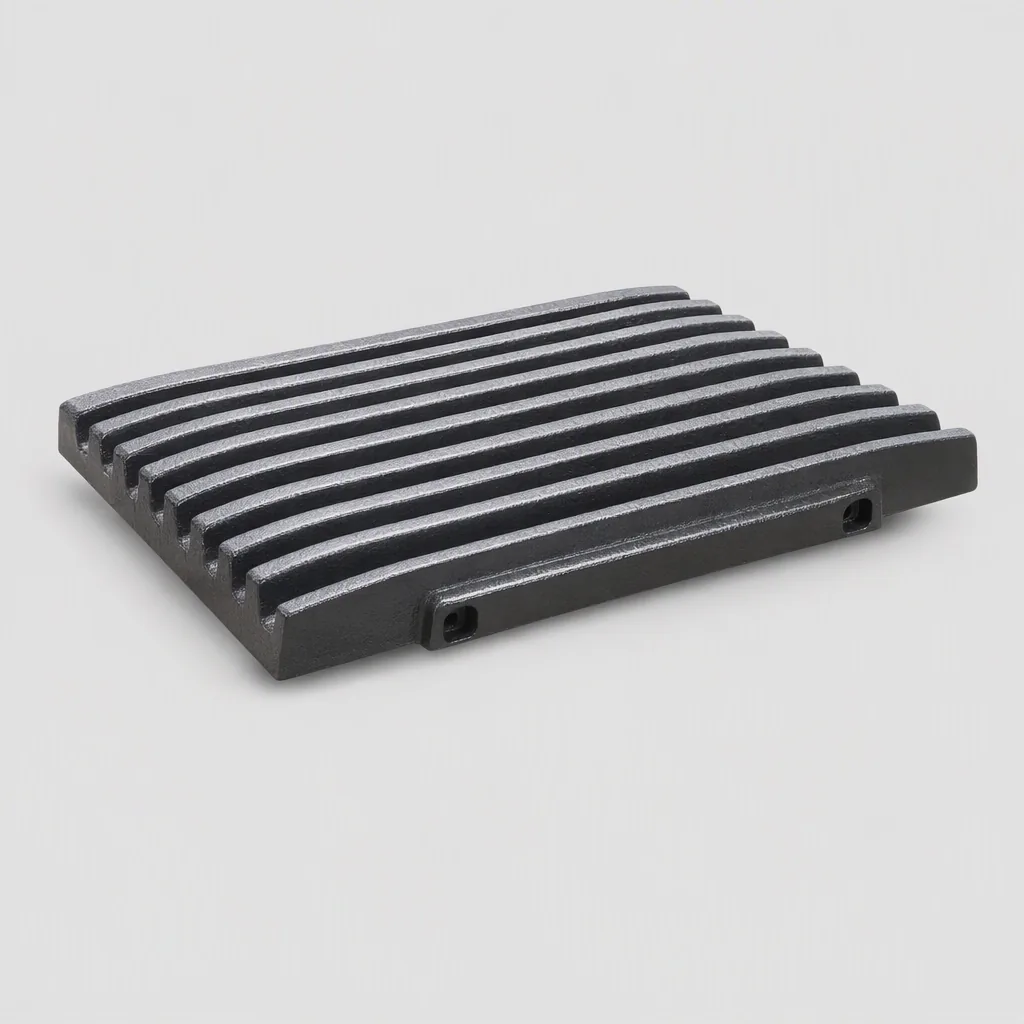
Fixed jaw, swing jaw and cheek plates. The jaw profile is part of the crushing chamber, not a finish: a corrugated plate bites coarse feed, a straight plate is for finer and more abrasive rock, and the tooth pitch has to match the feed top size or the jaw either slips or packs. Manganese work-hardens, so a plate that is fed evenly outlasts a thicker one that is fed to one side. Plates can be turned end for end where the profile allows; cheek plates wear from fine material leaking past the ends and are the cheapest part of the set to replace on time.
General Specifications
MaterialMn13Cr2 / Mn18Cr2
HardnessHB 180–220 after water toughening (work-hardens in service)
Heat TreatmentWater toughening (solution treatment)
CastingSand casting; lost-foam available
DimensionsOEM dimensions or made to your drawing
SurfaceShot-blasted; painted on request
MOQ1 set, negotiable
Lead TimeStock items or made to order
Design Features
ScopeSwing jaws, fixed jaws and cheek plates
Custom workTooth profile matched to your feed and closed-side setting
Applications
Jaw crushers Quarries Granite & basalt Recycled aggregate
Three plates, three different jobs
A jaw crusher does not have "a jaw plate". It has a fixed jaw, a swing jaw, and two cheek plates — and they are not interchangeable in function. The fixed and swing plates form the crushing chamber and take the compressive load; the cheek plates close the sides of that chamber and do not crush anything.
That distinction matters commercially: the cheek plates are usually the cheapest item and the one that gets left out of the enquiry, and the pair that does the crushing has to be specified together because the chamber geometry is the sum of both faces.
The tooth profile decides throughput before it decides wear
A coarse, aggressive tooth grips large feed and reduces the risk of a slab riding up in the chamber. It also wears unevenly in abrasive stone, because the tooth tips take the load and the valleys between them do not. A flatter, quarry-style profile wears more evenly and holds discharge size better, at the cost of some grip on coarse feed.
This is why two plates with identical dimensions can perform very differently in the same crusher. The profile has to be matched to the feed and to the closed-side setting, not to the drawing alone.
HB 180–220 is the hardness as delivered, not in service
Manganese plates are supplied solution-treated — water toughened — at around HB 180–220, and that is deliberately not a hard surface. Manganese steel work-hardens under impact: the working face hardens as it is hammered by the feed, while the core stays tough enough to absorb the load without cracking.
The practical consequence is that a low delivery hardness is not a defect, and a higher delivery hardness is not automatically better. Mn13Cr2 and Mn18Cr2 are the grades supplied; which one fits follows the impact level of the duty rather than a preference for the higher number.
What to send with a jaw plate enquiry
- Crusher make and model, or the plate drawing
- Feed material, maximum feed size and moisture
- Closed-side setting, since the profile is matched against it
- Quantities for fixed jaw, swing jaw and cheek plates stated separately
- Whether the failure being fixed is premature cracking or gradual wear — the two point to different plate choices
- Whether OEM dimensions or a drawing-based supply is acceptable
Frequently asked
Do I need the cheek plates as well?
Usually yes, and they are worth including in the enquiry rather than ordering later. They are the cheapest item in the set, and severe cheek wear exposes the crusher frame — which turns a plate replacement into a repair.
Why is the delivered hardness only HB 180–220?
Because manganese steel is meant to harden in service. It is solution-treated and supplied tough at around HB 180–220, then work-hardens under impact while the core stays ductile. A higher as-delivered hardness would trade away the toughness that keeps the plate from cracking.
Which grade should be chosen, Mn13Cr2 or Mn18Cr2?
It follows the impact level of the duty, not a preference for the higher number. Both are supplied; the choice is confirmed against the feed and the failure you are seeing. Higher manganese is not automatically the better plate.
Coarse tooth or flat profile?
Coarse tooth grips large feed but wears unevenly in abrasive stone. A flatter, quarry-style profile wears more evenly and holds discharge size better. Match it to the feed and the closed-side setting — two plates of identical dimensions can behave very differently.
Can plates be made to OEM dimensions?
Yes. Supply is to OEM dimensions or made to your drawing. The drawing is the controlling document for dimensions, tooth profile and fixing arrangement.
What surface finish and packing are supplied?
Shot-blasted as standard, painted on request. Quantity is one set, negotiable, and lead time depends on whether the item is a stock pattern or made to order — both are stated on the quotation.
Is the plate inspected before shipment?
Yes — dimensions against the drawing and hardness on the finished plate are checked before shipment. The documentation that comes with a specific order is stated on the quotation for that order.
More from this series
Related guides