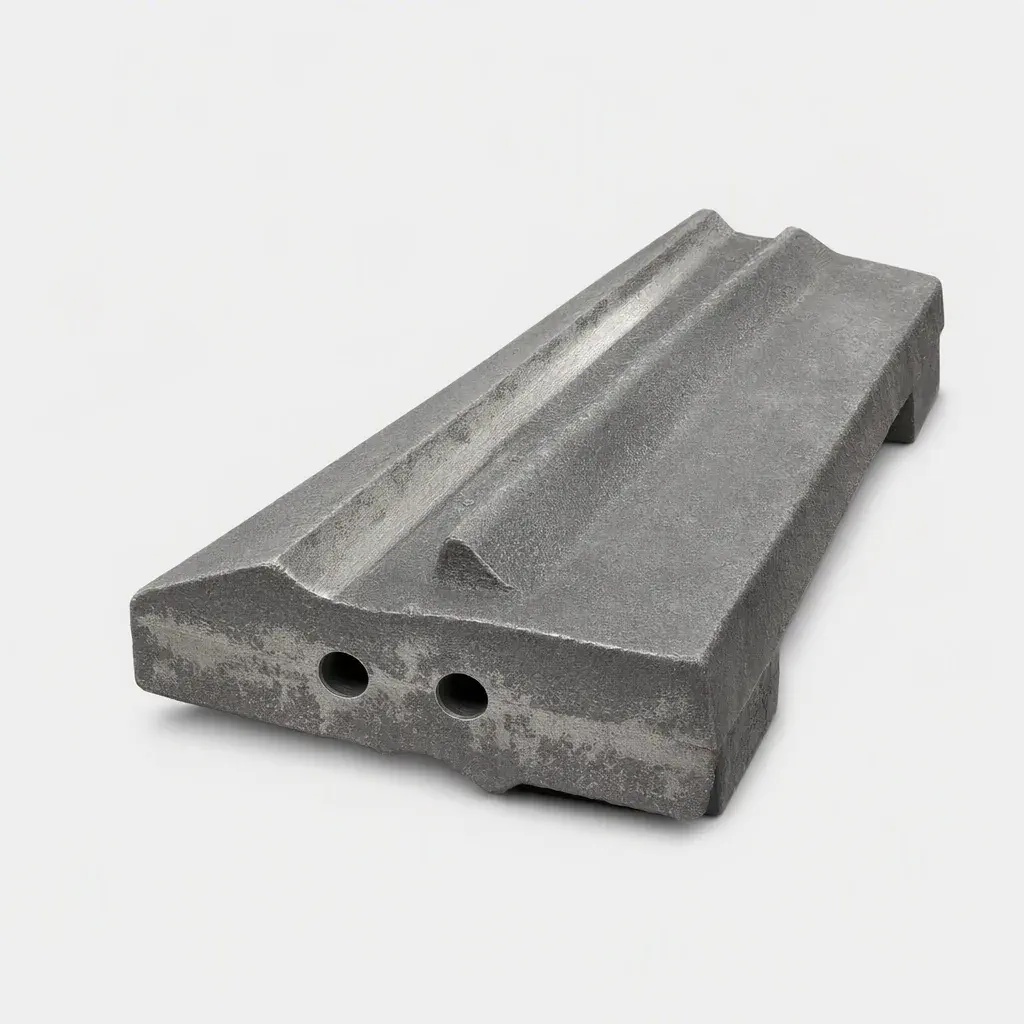
Blow bars are a choice between two failure modes, and the feed decides which: high-chrome holds its shape against small, abrasive feed and gives the longest life per tonne, but it is brittle and large lumpy rock will chip it; manganese steel deforms instead of chipping and is the right bar when the feed has big pieces, at the cost of faster wear. Rotor speed and the curtain gap decide how much of the work the bar does at all — a bar set too far from the curtain wears on the face without crushing much.
General Specifications
MaterialHigh-chrome (Cr26) or manganese steel
HardnessHRC 58–62 (high-chrome) / HB 180–220 (Mn)
Heat TreatmentQuenching and tempering (high-chrome) / water toughening (Mn)
CastingSand casting; lost-foam available
DimensionsOEM dimensions or made to your drawing
SurfaceShot-blasted
MOQ1 set, negotiable
Lead TimeStock items or made to order
Design Features
ScopeBlow bars with toothed striker face for impact crushers
SelectionChrome grade matched to feed abrasiveness — tell us your material
Applications
Impact crushers Limestone Recycling Aggregate plants
A blow bar is supplied as a matched set
Blow bars are mounted in rows on the impact crusher rotor, and the rotor is balanced as an assembly. That is why bars are supplied as a matched set rather than one piece at a time: replacing a single bar while its neighbours are worn moves the rotating mass to one side, and the imbalance shows up as vibration, extra bearing load and eventually a cracked bar.
A bar is also a wear component with a fixed seat. Its length, fixing arrangement and working profile are set by the rotor. A bar that fits the seat but does not match the rotor profile will not throw material the way the crusher was set up to throw it.
High-chrome or manganese: the abrasion-versus-impact trade-off
There is no single best blow-bar material. High-chrome cast iron gives strong abrasion resistance, particularly in limestone and well-controlled aggregate feed, but it is less forgiving under heavy impact or uncrushable contamination. Manganese steel is tougher and more impact-resistant, but it can wear faster in abrasive feed.
The practical question is which failure the plant can live with. A high-chrome bar in a duty that sees tramp metal tends to crack or break; a manganese bar in a highly abrasive, low-impact duty tends to wear out early. Match the material to the failure actually seen on site rather than to a headline wear figure.
| High-chrome (Cr26) | Manganese steel |
|---|
| Abrasion resistance | Strong — the usual option for abrasive, low-impact feed | Lower — wears faster in abrasive feed |
| Impact tolerance | Less forgiving under heavy impact or tramp metal | Tougher and more impact-resistant |
| Failure to watch | Cracking or breakage after uncrushable feed | Rapid wear across the working face |
| Typical duty | Limestone and well-controlled aggregate feed | Heavy-impact duties and feed with contamination risk |
What to establish about the feed before choosing
Material choice is decided by the feed, so the feed has to be described before a quotation means anything. Five points carry most of the decision.
- Feed material and how abrasive it is — limestone and clean aggregate behave differently from slag or demolition rubble
- Maximum feed size against what the crusher was built to take
- Whether tramp metal or uncrushable material can reach the rotor
- Required product size and throughput, since both change how hard the bars work
- The failure actually being seen: worn face, rounded profile, cracking, or a broken bar
What to send with a blow bar RFQ
Every item below is something the plant already has on file. With them, a quotation can be built against the rotor rather than against a generic bar.
- Crusher make and model, and the rotor it carries
- Existing bar drawing, or the bar itself when no drawing exists
- Material required — high-chrome or manganese — and the reason for the choice
- Feed material, maximum feed size and required product size
- Photographs of the current wear pattern or of the failed bar
- Quantity as a set, and whether a full rotor set or selected rows
- Whether OEM dimensions or made to your drawing
Frequently asked
Can one worn blow bar be replaced on its own?
Not recommended. The rotor is balanced as an assembly, so a single new bar against worn neighbours puts the imbalance on one side. Bars are supplied as a matched set for that reason.
Which material should be chosen, high-chrome or manganese?
It depends on which risk dominates: abrasion or impact. High-chrome gives stronger abrasion resistance in well-controlled feed; manganese is tougher where heavy impact or tramp metal is a real possibility. State the failure you are seeing and the choice can be checked against it.
Can bars be made to OEM dimensions?
Yes. Supply is to OEM dimensions or made to your drawing. The drawing is the controlling document for length, fixing arrangement and working profile.
What surface finish do the bars come with?
Shot-blasted as standard. A painted finish can be applied on request.
What is the minimum order quantity?
One set, negotiable. A set means the scope you specify — a full rotor set or selected rows.
How do I know when the bars need replacing?
Watch the working face rather than a fixed hour count: a face that no longer holds its profile, a rounded or polished striking edge, cracking around the fixing points, or a throughput drop with unchanged settings. An hour-based schedule only holds while the duty stays the same.
Why did a high-chrome bar crack?
High-chrome is strong in abrasion and less forgiving in impact. Cracking usually follows uncrushable material passing the rotor, or a bar run past the point where its working profile has worn through. Describe what was in the feed and the material can be checked against the duty.
More from this series
Related guides