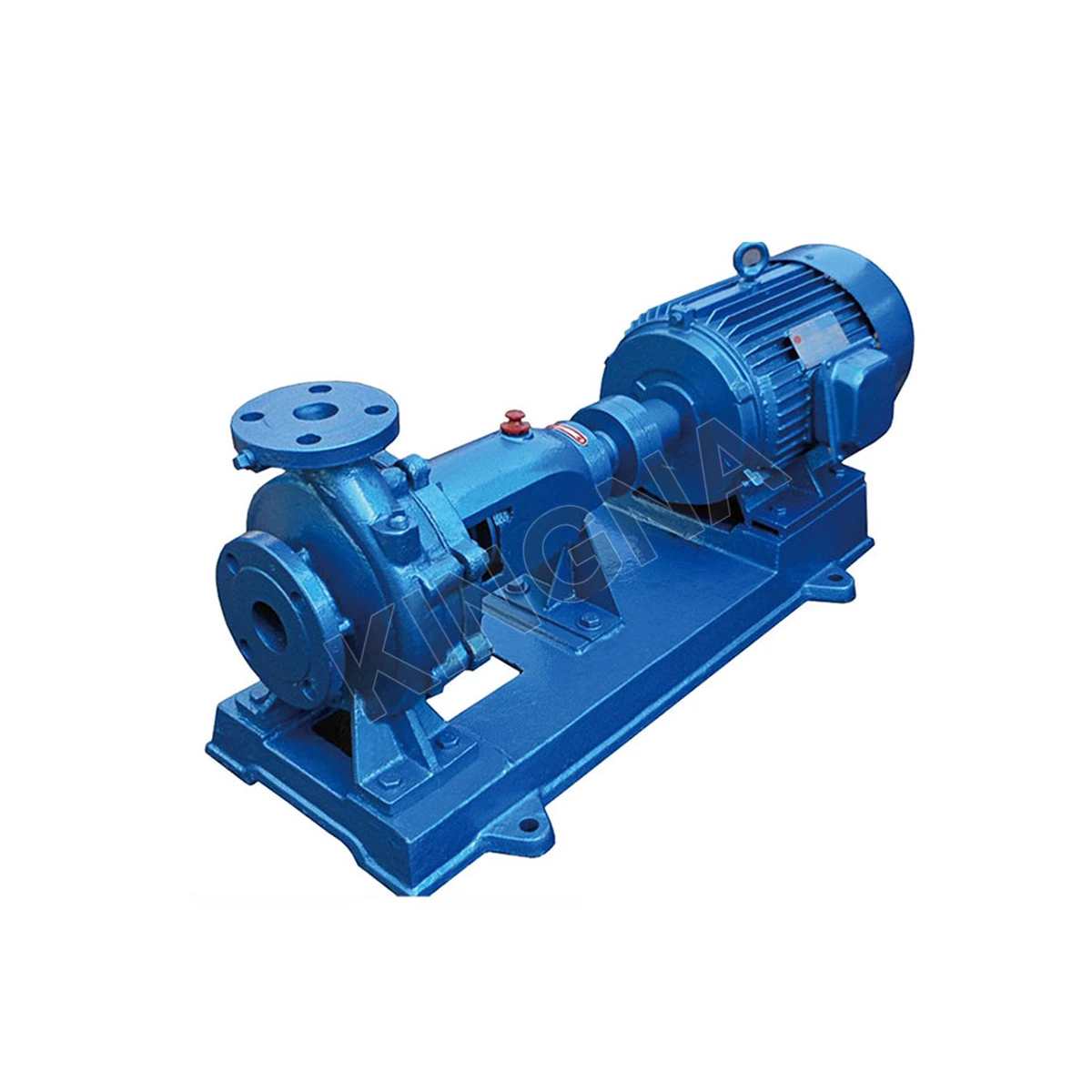
Built to ISO 2858, which is the only reason to choose this series: the flange positions and the hydraulic envelope match the standard range that the plant, the consultant and the imported pump already use, so a unit can be swapped without re-piping. Cast iron for clean water, stainless (IH) on request for lightly aggressive liquid. Each size is published with an untrimmed impeller and A, B and C trims, so one casing covers several head points — that is what makes it usable as a plant standard. 3.25–240 m³/h, 4–125 m, 0.75–110 kW at 1450 or 2900 r/min.
General Specifications
Inlet / Outlet Bore50–125 mm / 32–100 mm, per model
Flow Rate3.25 – 240 m³/h
Head4 – 125 m
Motor Power0.75 – 110 kW
Speed1450 / 2900 r/min, two speed families
StructureSingle-stage, single-suction, end suction centrifugal, close-coupled on a common base with motor
Design StandardISO 2858 dimensions and performance
Model DesignationInlet bore – outlet bore – impeller diameter, e.g. 100-80-160; A / B / C = trimmed impeller
Model Range50-32 · 65-50 · 65-40 · 80-65 · 80-50 · 100-80 · 100-65 · 125-100
SelectionSeries ranges are for preliminary selection; the final model is chosen against the duty point on the printed performance table.
Max. Working Temperature≤ 80 °C
Materials & Coating
CasingCast iron (IS build)
Chemical BuildStainless wetted parts (IH build) — quoted on request
Performance DataEfficiency, shaft power and NPSHr stated per model in the printed performance table
Applications
Water supply and pressure boosting Cooling water circulation Irrigation and general transfer Light chemical and process water
Where an ISO 2858 end suction pump earns its place
ISO 2858 fixes the flange positions and the hydraulic envelope, so a pump of this series drops into a line designed around the standard without adaptors or pipe changes. That is the reason it is the default in plants that keep one piping and spares standard rather than one machine per duty.
The range is broad for a single casing family: the A, B and C impeller trims mean the same pipe layout covers a duty that needs 40 m and one that needs 100 m, by changing the impeller and the motor rather than the installation.
What decides the model, and what to send
Flow, head, medium and temperature decide the size; the duty point on the printed performance table then decides the trim and the motor. Where the duty falls between two sizes, the correct answer is the one whose best efficiency point sits nearest the duty — a pump chosen one size large runs off its curve and pays for it in power.
Send flow, head, medium and temperature, the supply voltage and frequency, and whether the pump is required as a bare shaft or on a base with motor. Efficiency, shaft power and the required NPSH are then quoted from the printed table for the exact model, not from the series range.
More from this series