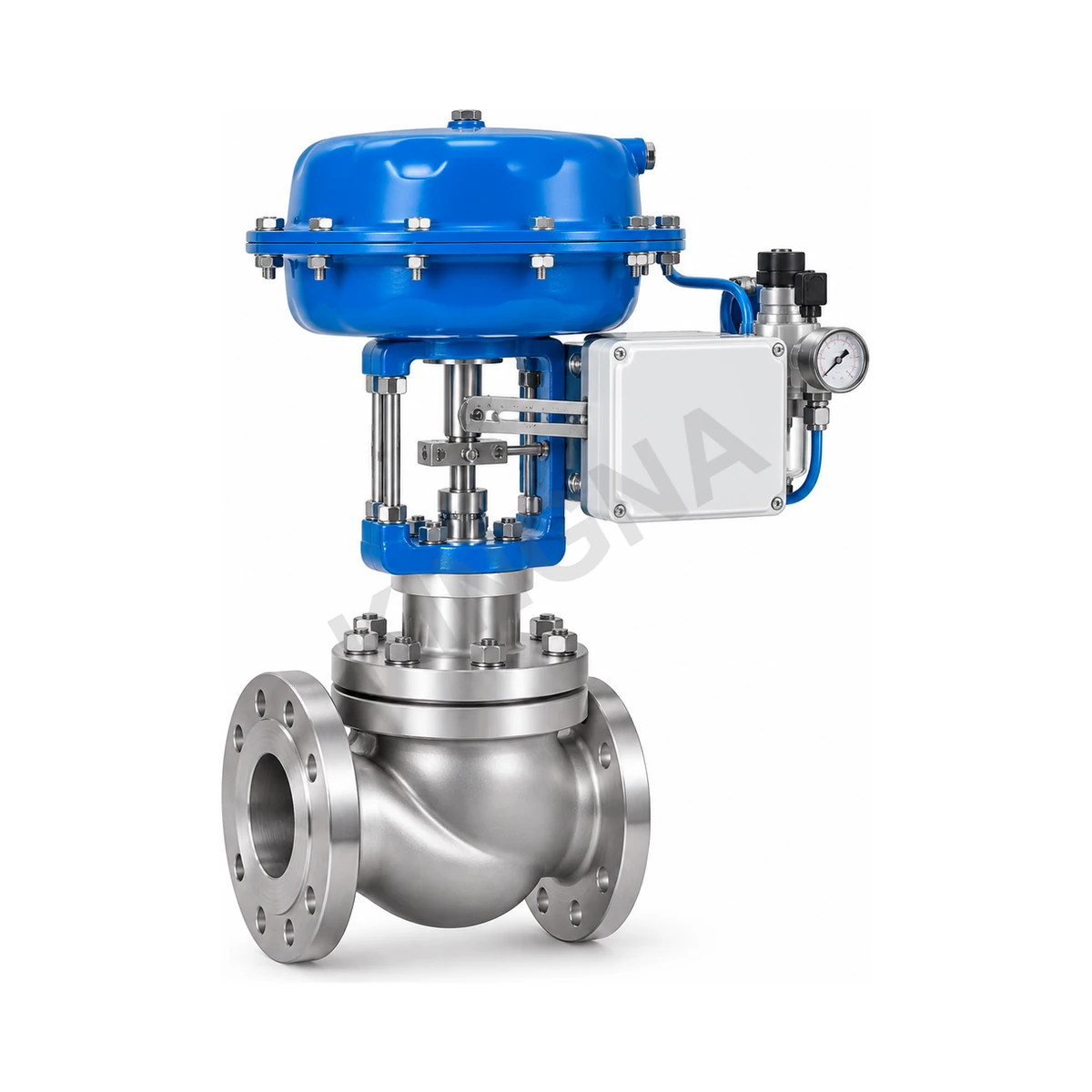
Pneumatic diaphragm control valve with linear stem travel: sleeve, cage single-seat, three-way and small-flow trims on one actuator family. It throttles flow; it does not isolate a line — trimming flow on a gate or knife gate is what cuts the seat away. Bodies in WCB, CF8, CF8M, CF3M, titanium or Hastelloy C276, DN15 to DN600, up to PN420 or 2500LB, −196 to 650 °C, leakage ANSI Class IV to VI. Trim, Cv, characteristic and fail position are fixed against the medium and the pressure drop, not against the pipe size.
General Specifications
TypePneumatic diaphragm control valve, linear stem travel
Size RangeDN15 – DN600 (per series)
Pressure RatingPN16 – PN420 · ANSI 150 – 2500LB
Temperature−196 to 650 °C, depending on trim and packing
Body MaterialsWCB / CF8 / CF8M / CF3M / Ti / Hastelloy C276
Leakage ClassANSI Class IV / V / VI depending on series
Kv Range0.0001 – 11500 depending on series
ActuatorPneumatic multi-spring diaphragm; handwheel available
PositionerElectro-pneumatic 4–20 mA available on request
Flow CharacteristicLinear or equal-percentage, stated on the data sheet for the selected trim
SettingTrim, Cv, characteristic and fail position fixed against medium, pressure drop and required Cv
Mediasteam / water / process fluid
Model Range
M — sleeve, double-seat pressure-balancedDN25–600 · PN16–420 / 150–2500LB · −196 to 650 °C · leakage ANSI IV · Kv 4–11500
MA — pilot-operated sleeve, pressure-balancedDN40–600 · PN16–420 / 150–2500LB · −196 to 650 °C · leakage ANSI V–VI · Kv 5–10500
G — cage-type single seat, ring-balancedDN25–600 · PN16–420 / 150–2500LB · −60 to 250 °C (−196 to 250 °C cryogenic) · leakage ANSI IV–VI · Kv 4–11500
Q / X — three-way mixing and divertingDN25–300 · PN16–2500 / 150–1500LB · −196 to 650 °C · leakage ANSI IV–VI · Kv 5.3–1200
HE — small-flow single seatDN15–25 · PN16–420 / 150–2500LB · −196 to 650 °C · leakage ANSI V–VI · Kv 0.0001–4
Applications
Phosphoric and sulphuric acid lines Slurry, thickener and reagent dosing duty Steam, condensate and hot-oil control Three-way mixing and diverting stations
Throttling is not isolating
A control valve throttles; it does not isolate. The knife gates and gate valves on this site close a line, and using one of them to trim flow is the most common way a plant destroys a seat: the medium passes at the edge of a partly open gate at full velocity until the seat and the gate are cut away. Where the duty is metering, the valve is a control valve, sized on Cv at the actual pressure drop and accepted on a leakage class.
That is why the valve is ordered against a data sheet rather than a pipe size. Two DN100 valves on the same line can be completely different parts: one balanced for a 40 bar drop with a Class IV seat, one unbalanced for 4 bar with a Class VI seat. The body may look the same.
The four answers that fix the trim
Four answers fix the trim: the medium and its concentration or solids content; the upstream and downstream pressure with the temperature, which together decide whether the trim will cavitate or flash; the required Cv at the duty point, and the leakage class the process can live with; and the fail position — air-to-open or air-to-close — plus the instrument air pressure available on site.
Send those and the series, the trim, the Cv, the characteristic and the actuator come back as one answer. Ordering from a size list alone is how a valve ends up either hunting at 10% travel or wide open with no authority left.
More from this series
Related guides